
Three colleagues and I share our takes on a late-summer channel check in Newport Beach, examining brand differentiation, merchandising and store experience – at Fashion Island, Lido Marina Village and A’maree’s. Let me introduce Carter Bolick, a product designer and developer and founder of India Rose, which serves the home furnishings industry; Katie Irving, founder of MOONSHOT, a fashion concept & product strategy studio; and Autumn Zimmerman, founder of MADE Trends, a trend forecasting, consumer insights, and business strategy consultancy for the fashion, retail, and consumer goods industries..
Fashion Island: The Unbearable Sameness of Athleisure
Ken: I’m going to start our conversation by asking a simple question: what struck you most about our time together walking the stores?
I’ll start with Fashion Island. All the athleisure brands were there — ALO, Athleta, Fabletics, Lululemon, and Vuori — but only ALO stuck out, with its strong “fashion first” positioning. The others simply had their stretchy stuff dressing forms, tables, and hangers. Just merch. No storytelling or even notes to lifestyle or activity.
Autumn: I agree with you. If you exclude ALO and add On, the active products are pretty interchangeable. So much so that I would argue if you conducted a double-blind product survey of women who shop the category, with labels removed, they would have a difficult time identifying the brands. The category is crowded and the products increasingly overlap, yet consumers don’t perceive the brands as interchangeable. It leaves a question for ongoing exploration: Why do some brands remain culturally desirable even after everyone piles into the same category?
Ken: You’d think that Lululemon, with its U.S. market share eroding, or Vuori, with its highly-innovative fabrics and newer classifications, would try to differentiate themselves more in visual presentation. Mostly, it was what I’ve been calling the “unbearable sameness of athleisure.”
Carter: Fashion Island has only a few home stores to choose from: Arhaus, RH, and Anthropologie. For me, the big game changer is Anthropologie. I feel a tug-of-war between the decline of its store design and visual display and the improvement of its new collections, displaying strong points of view and reflecting current trends from Pinterest Predicts, Etsy, and other tastemakers in the space.
There were tables and shelves filled with country-cottage plaids and florals that felt very British, or as Katie said, very Cotswold. From bathmats and glassware to valise stands, pillows, and bedding, the assortment felt feminine and traditional—almost like the Laura Ashley of yesteryear, but cooler and more Lone Fox in dusty pastels. Bravo. I was relieved that Anthro was back to not looking like everyone else in home.
Katie: I noticed that Aerie is clearly diverting floorspace away from intimates to sportswear. I’m wondering if this is a defensive move that’s tied to American Eagle’s stalled growth [let’s revisit after AEO announces Q2 on 9/9] after the Sidney Sweeney “best jeans” backlash, while Skims and a resurgent VS pressure their core category. #AerieReal is still their sharpest positioning asset in that age group, and I hope they can maintain it. I think that their customers don’t necessarily correlate them with Eagle, and maintaining that perceptual separation will be vital for them if they want to continue their impressive run.
Anthropologie and Evereve are the clearest examples of brands that know exactly who they’re dressing and design for her appetite, not around it. Evereve in particular is doing strong work with a mid-to-late trend adopter (barrel jeans, faux-leather jackets) who’s felt alienated by the industry. It’s approachable without being condescending. Farm Rio (which I shopped on Abbott Kinney recently) is the more aggressive version of the same idea: a 12″ shell appliqué on a dress shouldn’t work, but it does, because it’s backed by a consistent lifestyle story and designed for a customer who is aspiring to Euro summer, eternal wedding guest, date nights, etc.
Lululemon is the inverse case study. They had more color on the floor, but in my opinion, isn’t the right fix for a brand that no longer feels like it’s being made for anyone specific (and if you’ve been to a Lulu outlet lately, you know where most of the color will end up.) In a category driven by innovation, Lulu’s product playbook feels stale.
Ken: Any other notes on Fashion Island?
Katie: I noticed some interesting things happening in Contemporary.
For the aspirational luxury customer, Veronica Beard and Varley read as a winning set of brands: women (who have been alienated by luxury’s price hikes) who want to look put-together and feminine for real occasions at an upper contemporary price point. They want natural fibers (zero poly) and styling that toes the line between classic and trend. Varley has moved from active into elevated lifestyle apparel. This is a durable whitespace — the gap left by luxury inflation — and these brands occupy it deliberately.
Finally, let’s talk Americana. Brixton’s over-the-top Americana felt more generic than authentic. That’s notable because Americana is doing real work elsewhere: Boot Barn, Tecovas, Buck Mason, Cherry. The 250th anniversary is a real driver here, but the underlying story is how brands are navigating a moment where the aesthetic has been partly co-opted by the political right. American Eagle is THE case study here — doubling down on the Sydney Sweeney of it all reads as a short-sighted bet on the wrong audience to drive their future growth (the numbers prove this out: consideration among 18-24 year-olds fell roughly 15-16 points, from 48.5% to 32.4%). Old Navy’s Cardi B ‘Most Wanted Denim’ campaign is another play on Americana, but I’m not sure it’s what the brand needs to get its momentum back with its core customer. Early social media impressions appear to be good, but are an increasingly unreliable metric of what actually drives sales.
Ken: OK, let’s head to the water. Impressions of Lido Marina Village?
Lido Marina Village: Curated SoCal Retail
Carter: I love this outdoor shopping space for its approachable smallness: it is thoughtfully designed around a spare marina setting, with beautiful maritime architecture and an easy sense of calm. Step aside Irvine Company and take a few notes on building materials alone. The village brings together upscale brands that work well together. I am focusing on a few brands at Lido. Though Jenni Kayne, Love Shack Fancy, and The Great are also worth our attention, they are not mentioned here.
Velvet rarely moves too far with its designs, but this season felt accessible, comfortable, and grounded in quality fabrics. The easy sets were strong: drawstring pants with matching tees, familiar dress silhouettes, and smocked bodices that are everywhere right now but feel especially refined here. The brand leads with quality and comfort over novelty. A bit boring, if I am honest.
Dôen is such a gorgeous, elegant, cohesive brand. Still, I wonder how long these lacy satin and silk dresses will continue trending. To me, they read more like negligée than anything else, which feels even more intimate inside a shop that is nearly closet-sized. The store sits within the larger footprint of Alchemy Works, and they pair well.
How can anyone resist the strongly merchandised collections at Roller Rabbit, all in a fun, youthful palette on white cotton — unless, of course, you hate it? I love this store because she is not afraid of who she is. Although the brand always looks somewhat the same, even when the prints change, it clearly understands its customer: sorority-dorm life, aspiring Nantucket, and the graduate of Vineyard Vines. Roller Rabbit has been working with Indian handblock-inspired prints since before the trend began building over the last two years. Other brands at Lido, including Serena and Lily and Amber Lewis, are also influenced by these historical patterns, though they express them in completely different ways.
Speaking of Amber Lewis, this fabulous store is tasteful, traditional, clean, and very much having her moment right now, with successful collaborations at Four Hands and Loloi. The Lido store is small, which works well for the brand. The bedding, decorative accessories, textiles, hardgoods, and furniture all live in a sophisticated autumnal palette and help lead the charge for the Traditional trend. TradLife is Home’s strongest trend right now: from Pottery Barn, McGee and Co., Crate and Barrel, and RH, no one is straying far from turned legs, bobbin detailing, patchwork quilts with handblock prints, slope-arm tight-back sofas, monogramming, and collections named Cotswold. Amber Lewis is an interior designer and tastemaker, and the brand feels as lovely as it is authentic. She has certainly influenced the lot.
Ken: I first discovered Faherty at Lido years ago (they opened their 4th store there in 2016, long before there was any significant press on them). Then, I was mesmerized by this new, unique-but-familiar, casual lifestyle brand. This visit — they now have 80+ stores and plenty of press — the experience was less mesmerizing: it’s the same, small store (625 sq ft??), and their late summer/fall assortment (the henleys, wovens and pants) feel just a little out of place in the mid-August, mid-heat wave, mid-afternoon sunshine on the marina dock. (That said, they are one of my favorite men’s brands right now…)
Autumn: If you “know,” you find all the brands you want at Lido, and if you aren’t in the know, you love everything you discover. It’s a perfect balance, and the entire place delivers an experience of aspirational, curated California living. True to its name, it feels like a village, with the likes of Goop, Clare V., Roller Rabbit and Velvet mixed with home interiors and lovely restaurants. The experience feels like stepping into a cute Instagram feed and makes visitors comfortable buying something to take a piece of that curated lifestyle home with them.
A’maree’s: The Power of a Distinctive Point of View
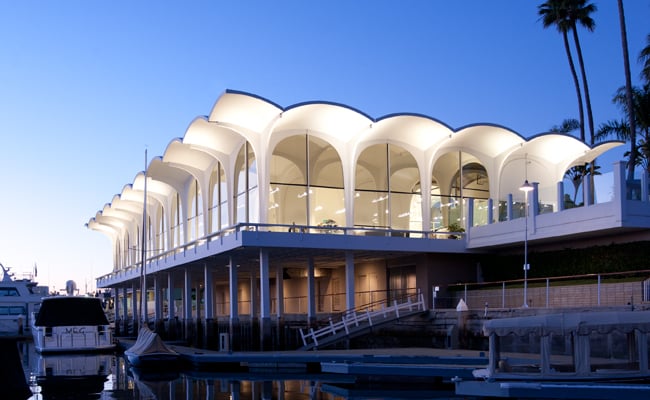
Ken: Across the Lido channel is A’maree’s (photo above), recently chosen as a “Top 6” independent global fashion store by Business of Fashion, and a “Top 50” Best Clothing Store in America by the New York Times. Founded by Nancy Brown in 1976, and then moved in 2011 to the stunning 8,000 sf, vaulted, modernist, harbor location (on stilts!) just off the PCH. It is still in the family and run by her daughters.
Autumn: A’maree’s serves a clear aspirational lifestyle, but beyond that, the product and merchandising have such a strong POV. I didn’t feel like I was anywhere I had been before, yet I never wanted to leave and felt a strong desire to personally own almost everything in the shop, including the stunning $27,000 Kilometre Paris Mineral Géologique tablecloth that would have absolutely no place in my home. In a moment of cultural sameness, it is refreshing to see a store with heritage so perfectly curated for an engaged customer.
What Newport Beach Retail Gets Right About Differentiation
Autumn: It was interesting to observe three completely different business models within the same community. As malls and mall culture begin to make a comeback with younger and older generations alike, Fashion Island is an interesting case study. Owned and operated by the Irvine Company, it doesn’t have all the bells and whistles of the newer, flashier experiential shopping centers (reference Westfield Shopping Centers). Nonetheless, it has the brands and retailers everyone wants, notably with less elaborate footprints. Lido offers an experience through its proximity to the waterfront and a highly curated mix of brands with small, edited assortments built around aspirational coastal California living. Where Lido offers an aspirational experience, A’maree’s is the GOAT: a perfectly merchandised assortment across categories, built around a lifestyle and customer understanding that feels truly refined and luxurious.